
Refugio County JP Precinct Routes
Refugio County's two justice courts divide the county by assigned precincts. JP1 serves precincts 1, 1A, 4, 4A, and 4B. JP2 serves 2, 2A, 2B, 3, and 3A. Each court keeps its own clerk and docket, so the precinct attached to a citation can point to the right starting office.
City citations go to the city court, not a JP by default. Felony and district case questions start with the District Clerk; County Court records go to the County Clerk. The official precinct information helps sort a county ticket before a status call.
Refugio County Bench Warrants Explained
A bench or failure-to-appear warrant is court process tied to a missed hearing, failure to answer a citation, contempt, or another unfulfilled court duty. In Refugio County, a traffic or city-ordinance FTA is usually checked first with the JP or municipal court named on the citation, not through a sheriff webpage.
Failure to satisfy a fine judgment may instead involve a capias pro fine. A family, child-support, or district matter can follow another court route. Ask for the exact label because everyday callers may use “bench warrant” for different court process.
Refugio County JP1 FTA Warning
The JP1 response form inspected for this build says a person who misses the citation response date can face an additional $350 FTA charge and an arrest warrant; it also warns of possible license-renewal denial. The form is older and names a past judge, so confirm current payment terms with the court. Its practical warning remains clear: a phone call alone is not an appearance.
The form says the covered response may be made by certified mail, in person, or through an attorney. It also says a not-guilty request requires an appearance and timely return of the form. Do not apply the $350 figure to JP2, a city court, or another case without confirmation.
How Refugio County Bench Warrants Are Issued
The judge or magistrate handling the underlying matter decides whether court process should issue. The specific court records the warrant and directs its own response. A sheriff, constable, city police officer, or another peace officer may receive or serve process as authorized, but Refugio County has no published service matrix assigning every bench warrant to one agency.
JP and municipal law now includes notice requirements for certain initial-setting failures and a voluntary-appearance rule. For an FTA warrant covered by the statute, a judge shall recall it when a person voluntarily appears and makes a good-faith effort to resolve it before execution, subject to the law and case facts.
Refugio County Voluntary Appearance Rule
Texas Code of Criminal Procedure Chapter 45A governs justice and municipal courts. It sets notice steps for certain failure-to-appear warrants and provides a recall path when a person voluntarily appears and makes a good-faith effort before execution. The court applies that rule to the particular case; it does not replace a call to the clerk or legal advice.
The official code page is linked below. Ask whether the warrant type qualifies, whether a hearing or payment is required, and how the clerk will record the recall. Refugio County has no local motion-to-recall form or filing fee published online.
Read the current Texas justice and municipal court code for the statutory framework.
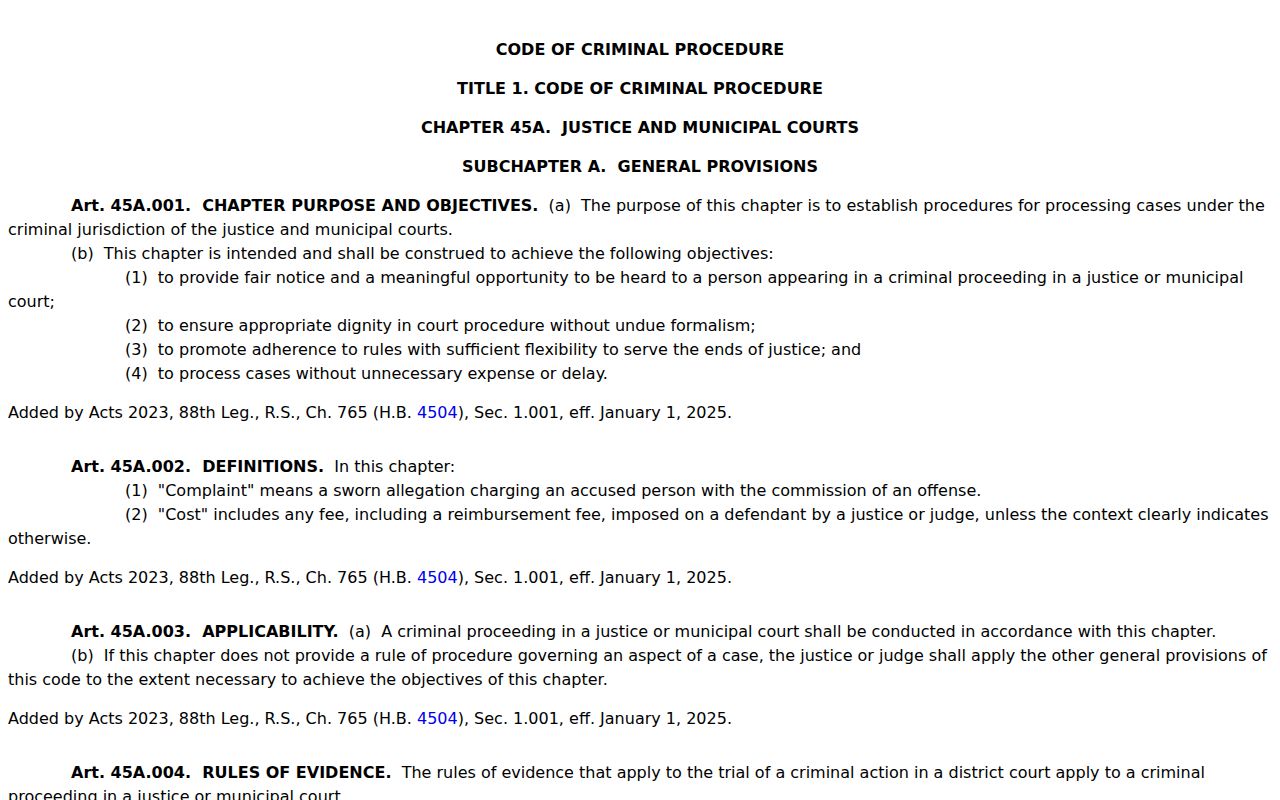
This image shows the state-law source; the local court still controls its case file and next setting.
Bench Warrants and Arrest Warrants Compared
In Refugio County, a bench or FTA warrant grows from an existing court duty. An arrest warrant follows a probable-cause complaint or other legal basis and may precede any missed hearing. Both can authorize custody, but the reason, court file, and path to resolve them differ. The arrest warrant process is covered separately.
| Feature | Bench Warrant | Arrest Warrant |
|---|---|---|
| Trigger | Missed date, FTA, contempt, or failure to comply | Complaint or other probable-cause basis |
| Issuing authority | Judge in the existing case | Magistrate or judge under Chapter 15 |
| Underlying file | Existing district, county, JP, or city matter | Criminal charge or complaint |
| Next step | Ask court about appearance, reset, recall, or bond | Confirm court, service, counsel, and bond route |
Capias Pro Fine Has Its Own Rule
A capias pro fine is not simply another name for every bench warrant. In Texas it enforces a fine judgment and must recite the judgment and sentence. Current law includes a hardship hearing before issuance in the covered nonpayment situation, and it sets steps for compliance and recall. Refugio County readers should ask the issuing JP or municipal court whether the court views the matter as an FTA warrant or a fine-collection capias.
Ask whether payment, a hearing, personal appearance, a plan, or another method is available. No countywide bond amount or uniform payment arrangement is published. The court that entered the judgment controls the answer.
Resolving a Refugio County Bench Warrant
Start with the court that set the missed date. Ask what type of warrant is recorded, whether the judge accepts a voluntary appearance, and what happens to the underlying charge. Refugio County has no public recall form, warrant window schedule, or countywide bond list. If the sheriff or jail says service has occurred, call before traveling and ask where custody questions are handled.
- Read the citation or case paper and identify the court and precinct.
- Ask the clerk about voluntary appearance, recall, reset, bond, or a hardship hearing.
- Speak with a lawyer before a surrender or motion if arrest is possible.
- Complete the court-approved step, keep the receipt or order, and confirm the status changed.
- Ask for the next hearing date; bond or release does not end the underlying case.
Caution: Do not assume an old missed date has gone away. Confirm status with the issuing court before travel, payment, or voluntary appearance.
Refugio County Recall Questions
There is no published Refugio County motion form, filing fee, bond schedule, or walk-in recall docket. A clerk can tell a caller whether a judge requires an appearance and where a request should be filed. A lawyer may ask for a reset, motion to recall or quash, personal bond, or a planned walk-through, depending on the record.
After a court action, ask when the docket and warrant record will update and whether the court reports a related FTA/FTP matter to DPS. The seven-business-day DPS window concerns processing of a reported violation, not the court's decision to recall a warrant.
Finding the Court That Issued the Warrant
The issuing Refugio County court controls the warrant's recall or quash decision. The sheriff may route a service question, but it cannot replace the clerk's case status. District Court records go to the District Clerk; constitutional County Court files go to the County Clerk; JP1, JP2, and each municipal court keep their own lower-level dockets.
Start from the court shown on the citation or case notice. If the court is unclear, use the county overview's Refugio County office map and call the sheriff for service routing. Give the clerk a case number and date of birth through the official channel, then ask which court date remains after resolution.